
Smart Sports Equipment Store Inventory Management: Zone X Solutions to Enhance Shopping Experience and Sales
With the growing interest in sports and fitness across Saudi Arabia, sports equipment stores are facing increasing challenges in product organization, inventory management, price updates, and delivering a seamless shopping experience.
Whether a store specializes in fitness equipment, sportswear, boxing gear, or tennis accessories, business success no longer depends solely on product variety. It also relies on management efficiency, easy access to information, and accurate daily operations.
This is where Zone X technology solutions play an important role in helping businesses improve their operations through business management systems, inventory management solutions, and Point of Sale (POS) systems, contributing to greater operational efficiency and easier store management.
The Importance of Smart Management for Sports Equipment Stores
Sports equipment stores offer a wide variety of products, ranging from dumbbells and exercise machines to bicycles, sportswear, rackets, and accessories.
This diversity makes store management more complex, particularly when dealing with different sizes, colors, models, and prices.
Some of the most common challenges facing sports retailers include:
- Difficulty tracking available product quantities.
- Price variations across products and models.
- Time-consuming manual inventory counting.
- Difficulty identifying best-selling products.
- Delays in updating prices and promotional offers.
- Limited visibility into inventory movement between branches.
- Challenges in generating accurate sales and profit reports.
Implementing an integrated management system helps organize these operations and provides accurate information to support better business decisions.
Organizing Sports Store Sections and Improving Customer Experience
Dividing a sports store into clearly defined sections is one of the most effective ways to help customers find suitable products quickly and easily.
A sports equipment store can be organized into several main areas:
1. Fitness Equipment Section
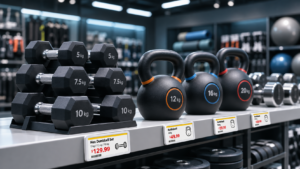
This section includes dumbbells, training weights, yoga mats, resistance bands, and other equipment used for home workouts and fitness centers.
Organizing products by weight, intended use, and price range makes comparison and selection easier for customers.
2. Combat Sports Section
This section includes boxing gloves, punching bags, and protective equipment.
Displaying related products together allows customers to select a complete set of training equipment conveniently.
3. Tennis and Racket Sports Section
This section includes tennis rackets, badminton equipment, table tennis accessories, balls, and related products.
Organizing items by sport, skill level, and price helps simplify the shopping experience.
4. Cycling and Outdoor Activities Section
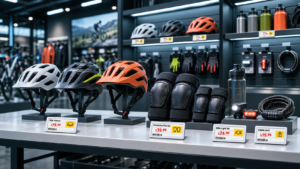
This section includes bicycles, scooters, helmets, protective equipment, and sports bags.
Dedicated display areas can be created for major products, with compatible accessories positioned nearby.
5. Sportswear and Accessories Section
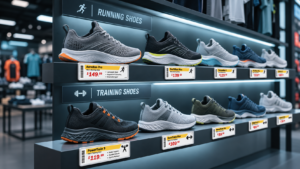
This section includes sportswear, athletic shoes, sports bags, socks, and other accessories.
With inventory management systems, store owners can track different product variations based on sizes, colors, models, and available quantities.
The Role of Zone X in Improving Sports Store Management
Modern retail stores need more than well-organized product displays. They require management systems that help monitor business operations and connect essential information.
Zone X solutions support business management through technology systems designed to organize and streamline daily operations.
Inventory Management and Product Tracking
Inventory management is one of the most important operations in sports equipment stores due to the wide range of products and variations available.
An inventory management system helps businesses:
- Register and categorize products systematically.
- Monitor available stock quantities.
- Track incoming and outgoing inventory.
- Simplify periodic stocktaking.
- Identify products that need replenishment.
- Monitor slow-moving and fast-moving items.
- Reduce errors caused by manual data entry.
This contributes to better purchasing decisions and reduces the risk of stock shortages or excess inventory.
Point of Sale (POS) Systems
Point of Sale systems play a vital role in improving the checkout experience and organizing financial transactions in sports retail stores.
Key benefits of suitable POS systems include:
- Recording sales transactions efficiently.
- Speeding up invoice generation.
- Applying prices and discounts according to system settings.
- Monitoring daily sales performance.
- Connecting sales transactions with inventory movements when both systems are integrated.
- Generating reports to evaluate store performance.
Using an integrated POS system helps reduce reliance on manual processes and improves the accuracy of business information.
Electronic Shelf Labels and Their Role in Modern Sports Retail
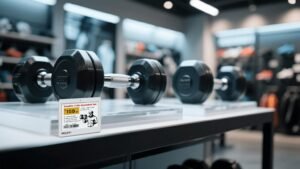
Electronic Shelf Labels (ESL) are among the technologies that can improve how prices and product information are displayed inside retail stores.
Instead of relying entirely on paper price tags, compatible electronic labeling systems allow stores to display product information on small digital screens attached to shelves.
Key Applications of Electronic Shelf Labels
Price Updates:
Product prices can be updated through a centralized system when the necessary technical integration is available, eliminating the need to replace paper labels manually.
Product Information Display:
Compatible electronic labels can display product names, prices, and selected specifications, depending on the capabilities of the devices used.
Promotional Offer Management:
Electronic labels help display discounted prices and seasonal promotions clearly.
Improved Customer Experience:
Customers can view essential product information while shopping, making it easier to compare different options.
Retailers can also explore integrating this technology with POS and inventory management systems as part of their digital transformation strategy, provided that hardware and software compatibility is verified before implementation.
Improving Pricing and Promotional Strategies in Retail Stores
Sports equipment prices frequently change due to seasonal promotions, supplier price adjustments, and discount campaigns.
Manual price management can sometimes lead to discrepancies between the prices recorded in the sales system and those displayed on store shelves.
A structured pricing system helps businesses:
- Manage product prices from a centralized source.
- Apply discounts accurately.
- Organize promotional campaigns.
- Monitor the impact of offers on sales.
- Reduce errors caused by manual price updates.
With compatible systems, integration can be extended to include digital price display solutions.
How Can Inventory Management Systems Reduce Costs?
Inaccurate inventory management can lead to purchasing more products than a store needs or running out of popular items during periods of high demand.
By regularly monitoring inventory data, business owners can identify:
- Products with the highest demand during specific periods.
- Items that require replenishment.
- Available stock quantities.
- Sales movements by category or product.
- Products with low inventory turnover.
This information helps improve purchasing decisions, optimize storage space, and allocate budgets toward products with proven customer demand.
Managing Multiple Store Branches Through a Centralized System
When a business operates multiple branches, monitoring inventory, sales, and pricing becomes increasingly complex.
Centralized business management systems, when configured to support multiple locations, help unify information and manage operations through a single platform.
Key benefits include:
Inventory Monitoring: Tracking available stock quantities at each branch.
Sales Tracking: Reviewing branch performance and analyzing sales results.
Pricing Management: Managing pricing policies and discount structures.
Improved Decision-Making: Comparing product and branch performance using reliable data.
Simplified Administration: Reducing the need to collect reports manually from multiple sources.
Reports and Analytics: Making Data-Driven Business Decisions
Sales and inventory reports help sports equipment store owners gain a clearer understanding of their business performance.
Instead of relying on assumptions, retailers can use data to answer important questions, such as:
- Which products generate the highest sales?
- When does customer demand peak?
- Which departments require improvement?
- Are promotional campaigns delivering the expected results?
- Which products are tying up capital due to slow inventory turnover?
These insights support better business planning and help improve sales and purchasing strategies.
Digital Transformation and Sustainability in Sports Equipment Stores
Digital transformation goes beyond accelerating sales transactions. It also helps businesses use resources more efficiently and reduce repetitive administrative tasks.
By adopting digital systems, retailers can reduce paper-based processes in certain operations, simplify stocktaking, and improve data organization.
Electronic display technologies may also help reduce the need for frequent printing and replacement of paper price labels when implemented appropriately.
This gives businesses an opportunity to create a more organized and efficient retail environment while improving operations to meet changing market demands.
Why Do Sports Equipment Stores Need Zone X Solutions?
As businesses expand and competition increases, accurate inventory and sales management becomes an essential factor in retail success.
Zone X helps business owners and commercial enterprises benefit from technology solutions that support more organized business operations.
By choosing suitable POS and inventory management systems, sports retailers can:
- Improve daily operational efficiency.
- Organize products and inventory categories.
- Monitor sales and stock levels.
- Reduce administrative errors.
- Improve inventory counting procedures.
- Use reports to support business decisions.
- Prepare for future business expansion.
Conclusion: Upgrade Your Sports Store with Zone X
Managing a successful sports equipment store is no longer just about offering a wide selection of products or creating attractive shelf displays.
Long-term success requires combining an organized shopping experience with an effective management system that helps monitor products, prices, inventory, and sales.
With Zone X, sports retail business owners can explore business management, POS, and inventory solutions tailored to their operational needs and business size.
Zone X – Your Path to Technology.
Start improving your store management today and discover technology solutions that fit your business.
