

The Importance of Biometric Attendance Devices in Companies: Zone X Solutions for Attendance Management and Improved Work Efficiency
With the development of work environments and the increasing number of employees in companies and organizations across the Kingdom of Saudi Arabia, attendance management has become one of the essential processes that require accuracy and organization to ensure efficient business operations.
Recording employees’ check-in and check-out times is no longer just a routine administrative procedure. It has become an important part of human resource management, monitoring working hours, organizing shifts, and preparing reports that help management make decisions based on clear and reliable data.
This is where the importance of biometric attendance devices becomes evident. These technological solutions help companies reduce their reliance on paper records, improve attendance accuracy, and simplify employee monitoring.
Through Zone X, companies and organizations can explore a range of biometric attendance devices and attendance management systems that suit their business needs, helping them improve administrative processes and enhance operational efficiency.
The Importance of Biometric Attendance Devices in Organizing Business Operations
Companies face various challenges when managing employee attendance, especially as the number of employees increases or when departments, work shifts, and locations expand.
Traditional manual recording methods may lead to difficulties in reviewing working hours, inconsistencies in attendance records, or excessive time spent preparing reports.
Some of the most common challenges faced by company management include:
- Difficulty accurately tracking employee check-in and check-out times.
- Spending excessive time manually recording attendance.
- Potential errors in calculating working hours.
- Difficulty monitoring repeated lateness and absenteeism.
- Complicated shift management in factories and facilities.
- Difficulty collecting attendance data from multiple branches.
- Increased administrative workloads for human resources departments.
- The need for reliable records to support payroll calculations.
Implementing a suitable electronic attendance system helps address these challenges by providing organized records that can be easily accessed and analyzed.
How Do Biometric Attendance Devices Work?
Biometric attendance devices verify an employee’s identity using a specific identification method and then record their check-in or check-out time in the device’s records.
Verification methods vary depending on the device type and specifications. Some devices support fingerprint recognition, others use facial recognition, and some also support electronic identification cards.
1. Fingerprint Recognition Devices
These devices use fingerprint recognition technology to verify an employee’s identity when recording attendance.
They help document attendance activities in an organized manner while reducing the need for manual data entry.
2. Facial Recognition Devices
These devices use facial recognition technology to verify the identity of a previously registered user.
This technology allows employees to record attendance without touching a fingerprint sensor, making it a suitable option for many work environments.
3. Multi-Verification Biometric Devices
Some devices combine fingerprint recognition, facial recognition, and electronic cards, giving companies multiple verification options suited to their employees and working environments.
Choosing the appropriate method depends on the number of users, security requirements, and ease of use within the organization.
The Role of Biometric Attendance Devices in Improving Company Management
The importance of attendance devices extends beyond recording employee check-in and check-out times. They also support various administrative processes related to organizing daily business operations.
Accurate Attendance Recording
Accurate recording of working hours is one of the most important advantages of biometric attendance devices.
Instead of relying on paper signatures or manual registration, check-in and check-out times are documented electronically.
This helps companies:
- Record employee check-in times.
- Document check-out times.
- Maintain records for future reference.
- Simplify attendance data reviews.
- Reduce errors caused by manual data entry.
These records provide a more organized foundation for monitoring compliance with working hours.
Reducing Attendance Record Manipulation
Some organizations face challenges related to employees recording attendance on behalf of others, especially when using attendance systems that do not verify individual identities.
Biometric attendance devices help reduce these practices by linking each attendance record to the registered user’s identity.
This contributes to improving the reliability of attendance records, provided that system permissions and settings are properly configured.
Simplifying Human Resources Management
Human resources departments need to regularly review attendance, lateness, and absenteeism records.
These tasks can consume considerable time when relying on manual records.
With biometric attendance devices and compatible software, several tasks can be simplified, including:
- Collecting employee attendance records.
- Reviewing check-in and check-out times.
- Generating attendance reports.
- Monitoring lateness and absenteeism.
- Preparing working-hour data for administrative review.
- Reducing the time required to prepare periodic reports.
This allows human resources teams to dedicate more time to other administrative and development tasks.
Organizing Work Shifts and Working Hours
Many factories, hospitals, and companies operate using multiple work shifts, making attendance and working-hour management more complex.
Attendance systems that support shift management help organize attendance data according to the schedules assigned to each employee group.
Key benefits include:
- Monitoring the beginning and end of each shift.
- Reviewing recorded working hours.
- Identifying late arrivals based on approved schedules.
- Simplifying overtime calculations according to system settings.
- Supporting the organization of working hours across different departments.
To benefit from these features, companies should select attendance management software that supports their existing shift structures.
Integrating Biometric Attendance Devices with HR and Payroll Systems
Modern companies increasingly rely on digital systems to connect administrative processes.
One of the most important applications is integrating attendance devices with Human Resource Management Systems (HRMS).
When technical compatibility exists between devices and software, attendance records can be used to support employee management and payroll operations.
How Does System Integration Help?
Monitoring Working Hours:
Collecting and reviewing attendance data through compatible management software.
Calculating Lateness and Overtime:
Using recorded check-in and check-out times to apply approved company policies.
Preparing Payroll Data:
Simplifying the transfer of information needed to calculate employee payments into integrated payroll systems.
Unifying Employee Information:
Reducing the need to manually transfer data between multiple systems.
Generating Reports:
Providing organized information that helps management review compliance with working schedules.
Zone X also offers human resource management solutions that can be explored through its Human Resource Management System (HRMS). However, compatibility between the selected biometric devices and the required software must be verified before implementing any integration.
The Importance of Biometric Attendance Devices for Multi-Branch Companies
When a company operates multiple branches or work locations, monitoring employee attendance becomes more complicated, especially when working hours or employee numbers differ between branches.
Centralized systems compatible with biometric attendance devices allow attendance records from different locations to be collected and managed more efficiently.
Potential benefits include:
- Collecting attendance data from multiple branches.
- Simplifying working-hour monitoring for each location.
- Reducing reliance on manually submitted reports.
- Reviewing absenteeism and lateness.
- Supporting administrative decisions based on unified data.
These capabilities depend on the type of biometric devices, available connection methods, and the software used to manage different branches.
The Role of Biometric Devices in Enhancing Security and Access Control
Some companies and organizations need to regulate employee access to specific departments or areas, such as administrative offices, equipment rooms, or locations requiring special permissions.
Access Control systems can use identity verification methods to determine which individuals are authorized to enter.
Suitable access control systems help:
- Organize access permissions.
- Reduce reliance on traditional keys.
- Document entry activities when supported by the system.
- Support the protection of restricted areas.
- Simplify the management of authorized users.
It is important to distinguish between attendance recording devices and actual door access control devices, as some applications require compatible controllers, locks, and additional accessories.
Biometric Attendance Devices Available at Zone X for Companies and Organizations
Zone X offers a range of attendance devices that vary in user capacity, verification methods, and connectivity options.
This variety helps companies choose devices that suit their workforce size and operational requirements.
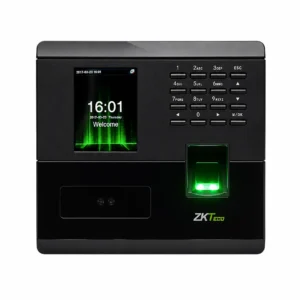
1. MB10 Attendance Device
The MB10 is a practical option for organizations that need to record attendance using multiple verification methods.
The device supports facial recognition, fingerprint recognition, and cards. It is easy to use and offers a suitable capacity for various companies and offices.
Key Specifications:
- Supports facial recognition, fingerprint recognition, and cards.
- Capacity of up to 200 facial records.
- Capacity of up to 500 fingerprints.
- Storage for up to 50,000 attendance transactions.
- Ability to export attendance records.
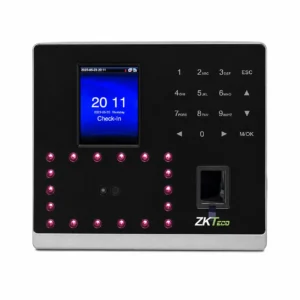
2. MB2000 Attendance Device
The MB2000 provides multiple features for managing employee attendance, supporting different verification methods and offering a larger storage capacity.
It also includes connectivity options that facilitate data transfer and management through compatible systems.
Key Specifications:
- Supports facial recognition, fingerprint recognition, and cards.
- Capacity of up to 2,000 facial records.
- Capacity of up to 3,000 fingerprints.
- Supports up to 3,000 cards.
- Stores up to 100,000 transactions.
- Supports Ethernet and USB connectivity.
- Supports the ADMS feature for data management and synchronization.
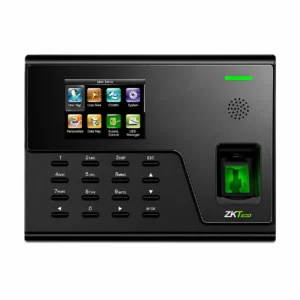
3. ZKTeco UA760 Attendance Device
The ZKTeco UA760 is used to record employee attendance through fingerprint recognition or electronic identification cards.
The device offers multiple connectivity methods for transferring records and monitoring attendance data.
Key Specifications:
- Supports fingerprint recognition and cards.
- Capacity of up to 3,000 fingerprints.
- Capacity of up to 3,000 cards.
- Stores up to 50,000 transactions.
- Features a 2.8-inch color display.
- Supports TCP/IP, Wi-Fi, and USB Host.
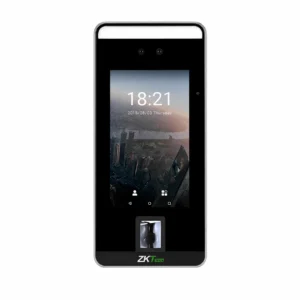
4. ZKTeco SpeedFace V5L[P] Biometric Device
The ZKTeco SpeedFace V5L[P] is one of the advanced options available for attendance management and access control.
It combines multiple verification methods with a large storage capacity, making it an option worth considering for organizations with more demanding operational requirements.
Key Specifications:
- Supports facial recognition, fingerprint recognition, and cards.
- Capacity of up to 6,000 facial records.
- Capacity of up to 6,000 fingerprints.
- Supports up to 3,000 cards.
- Stores up to 200,000 transactions.
- Features a 5-inch color touchscreen.
- Suitable for attendance management and access control applications, depending on installation requirements.
How to Choose the Right Biometric Attendance Device for Your Company
Choosing the appropriate attendance device depends on several factors related to the size of the organization, the nature of its operations, and its administrative requirements.
Number of Employees
It is important to ensure that the device’s capacity supports the number of registered employees while considering future expansion plans.
Verification Methods
Companies can choose between fingerprint recognition, facial recognition, or identification cards depending on their working environment and user requirements.
Record Storage Capacity
Organizations that record a large number of daily attendance transactions need devices with sufficient storage capacity.
Connectivity Options
Devices vary in their support for network connections and USB data transfer. Therefore, companies should select connectivity options that suit their existing technical infrastructure.
Compatibility with Management Systems
If a company uses human resource management or payroll software, it is important to confirm that the selected device can integrate with the system before purchasing it.
Technical Support and Maintenance
Access to suitable technical support helps simplify device configuration, resolve technical issues, and maintain business continuity.
Protecting Employee Data When Using Biometric Attendance Devices
Protecting employee data is an important consideration when implementing biometric attendance systems.
Fingerprint and facial recognition data are linked to individuals’ identities and must therefore be handled in accordance with the privacy and data protection regulations applicable in the Kingdom of Saudi Arabia.
Important practices include:
- Defining access permissions for employee data.
- Choosing devices and software that provide suitable security measures.
- Clarifying the purpose of collecting and using data.
- Retaining data only for the necessary period in accordance with regulatory requirements.
- Establishing procedures to protect records and backup copies.
- Providing suitable procedures for situations where biometric verification is unsuccessful.
Paying attention to these aspects helps maintain a balance between administrative efficiency and employee privacy.
How Do Biometric Attendance Devices Help Reduce Administrative Costs?
Manual attendance management can require significant time to review records, prepare reports, and correct errors.
Implementing a suitable electronic attendance system can help reduce the time and effort involved in these processes.
Key areas that can be improved include:
- Reducing repetitive paperwork.
- Simplifying report generation.
- Reducing attendance recording errors.
- Organizing working-hour data.
- Accelerating employee attendance record reviews.
- Reducing the need to enter data multiple times when system integration is available.
Actual results vary depending on the organization’s size, the implementation method, and the level of integration with administrative software.
Why Choose Biometric Attendance Solutions from Zone X?
As companies and organizations continue to develop, the need for integrated technology solutions has become increasingly important for improving daily operations.
Zone X provides a range of biometric attendance devices that meet different requirements, along with technological and administrative solutions that help organizations develop their working environments.
By choosing the right solution, companies can benefit from:
- Attendance devices with multiple verification methods.
- Different options in terms of user capacity and record storage.
- Attendance management solutions.
- Connectivity and data transfer capabilities depending on the device.
- Supply and technical support services.
- The possibility of integrating devices with compatible human resource management systems.
- Access control solutions according to organizational requirements.
Having a variety of products helps companies select devices based on their actual operational needs rather than relying on a single solution for every type of organization.
You can explore the available options through the Biometric Attendance Devices and Access Control category at Zone X.
Conclusion: Organize Employee Attendance and Improve Company Management with Zone X
Biometric attendance devices are no longer simply tools for recording employee check-in and check-out times. They have become an important part of technological solutions that help companies organize working hours, improve data accuracy, and simplify human resource management.
By selecting a suitable attendance device and integrating it with compatible management systems when needed, organizations can establish a more organized approach to attendance monitoring and reducing administrative errors.
With Zone X, companies and organizations across the Kingdom of Saudi Arabia can explore a range of biometric attendance devices and technology solutions suited to their operational requirements and organizational size.
Explore the biometric attendance devices available at Zone X and choose the right solution to organize attendance management in your company.
Website: https://zonex-pro.com/
For Inquiries: 0541168537
Zone X – Your Path to Technology.
