

Electronic Shelf Labels: How to Update Product Prices in Stores Easily and Accurately
Imagine a supermarket starting its day with a promotional campaign covering hundreds of products. However, some shelf labels still display old prices, while the point-of-sale (POS) system has already been updated with the new ones.
Employees must print new paper price tags, locate each product, and manually replace its label. Meanwhile, customers may discover price differences when they reach the checkout counter.
This is more than a minor operational delay. It creates unnecessary workloads, increases the possibility of pricing errors, and can negatively affect the shopping experience.
This is why many retailers are adopting electronic shelf labels (ESLs) as a modern solution for displaying product information and updating prices through a centralized management system rather than manually replacing printed labels.
In this comprehensive guide, we explain how electronic shelf labels work, their installation process, practical applications across different retail sectors, and the key factors to consider when selecting the right solution.

What Are Electronic Shelf Labels?
Electronic shelf labels are small digital displays installed along shelf edges or near products to show prices, product names, and other relevant information.
Depending on the device and management system, these labels may also display:
-
Product barcodes.
-
QR codes.
-
Promotional prices.
-
Product specifications.
-
Special offers and discounts.
Many electronic shelf labels use electronic paper (E-paper) technology, which provides clear visibility and primarily consumes energy when displayed information changes.
Other display technologies may also be available for different retail environments and operational requirements.
Electronic shelf labels are not simply standalone digital price tags. They are typically part of an integrated system that includes a product database, management software, wireless communication infrastructure, and mounting accessories.
Therefore, successful implementation depends on compatibility between all system components, rather than the appearance or price of the labels alone.
Why Are Traditional Paper Price Tags Becoming a Challenge for Retailers?
Managing paper price labels becomes increasingly difficult as the number of products grows and promotional campaigns become more frequent.
In a traditional pricing system, employees must identify products requiring updates, print new price labels, distribute them across departments, replace existing labels, and verify that the displayed prices match the POS system.
The process becomes even more complicated for retailers operating multiple branches, especially when promotional campaigns must begin at a specific time across all locations.
Manual price updates can result in several operational challenges:
-
Outdated prices remaining on shelves.
-
Price labels being attached to incorrect products.
-
Delays in activating limited-time promotions.
-
Differences between shelf prices and checkout prices.
-
Increased employee workload.
-
Difficulties maintaining consistent prices across branches.
Although the frequency of these problems varies between retailers, they demonstrate why businesses are increasingly interested in reducing manual processes and improving pricing accuracy.
How Do Electronic Shelf Labels Work? From Price Changes to Shelf Updates
Electronic shelf label systems connect product pricing information to digital displays through centralized management software and compatible communication infrastructure.
The process begins with an approved pricing source, typically a POS system, enterprise resource planning (ERP) platform, or product management database.
When an authorized employee changes a product’s price, the updated information is transferred to the electronic shelf label management platform through the configured integration.
The system identifies the digital label associated with the product and sends the updated information through a compatible wireless gateway or communication network.
Once the electronic label receives the command, its display updates to show the new information.
Some systems allow administrators to monitor connectivity, track update delivery, and identify labels that have not successfully synchronized.

However, these capabilities and synchronization speeds vary depending on the manufacturer, store size, wireless coverage, and number of connected labels.
The most important requirement is ensuring that shelf prices and checkout prices are connected to the same approved pricing source or supported by a reliable verification process.
This helps retailers reduce price discrepancies and maintain more consistent pricing information.
Practical Example: Launching a Promotion Across 200 Products
Consider a supermarket planning a weekend promotional campaign involving 200 products.
With traditional paper labels, employees would need to prepare new price tags, distribute them across the store, replace the existing labels, and verify the changes.
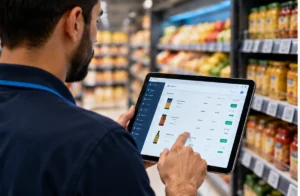
With an integrated electronic shelf label system, the pricing manager can review the planned changes, select the implementation time, and monitor the status of the targeted labels.
Although operational verification remains necessary, the need for manually replacing hundreds of price tags can be significantly reduced.
This approach can be especially useful for retailers that regularly run seasonal promotions, weekend discounts, or limited-time campaigns.
How to Install Electronic Shelf Labels in a Store
Implementing electronic shelf labels requires more than attaching digital screens to shelves. A successful installation begins with understanding the store’s operational requirements and existing technology infrastructure.
1. Assess the Store and Identify Requirements
The first step is evaluating the number of products, shelves, display locations, and environmental conditions.
Retailers should determine whether the labels will be installed on standard shelves, refrigerated displays, or areas exposed to higher humidity levels.
The assessment should also consider display sizes, mounting methods, wireless network requirements, and existing pricing procedures.
2. Select the Devices and Configure Connectivity
Electronic labels should be selected according to the amount of information they need to display, screen readability, battery requirements, and operating environment.
Wireless gateways or other supported communication infrastructure are then positioned according to the supplier’s technical recommendations.
Network coverage should be tested across aisles, corners, and other relevant areas before proceeding with full installation.
3. Link Each Label to the Correct Product
Each electronic label is typically associated with a product identifier or barcode within the management system.
This connection is essential because incorrect product-to-label mapping can cause the wrong price to appear, even when the central database contains accurate information.
Employees must verify that every electronic display matches the product located directly above or beside it.
4. Test Updates and Train Employees
Before launching the complete system, retailers should test several operational scenarios, including:
-
Updating selected product prices.
-
Activating a temporary promotion.
-
Resynchronizing a disconnected label.
-
Replacing or relocating an electronic label.
-
Verifying price consistency between shelves and checkout terminals.
Employees should also receive training on managing labels, troubleshooting basic issues, and maintaining pricing accuracy during daily operations.
Where Are Electronic Shelf Labels Used?
Electronic shelf labels can support various industries and retail environments, particularly businesses that manage numerous products or frequently update pricing information.
Supermarkets and Hypermarkets
Supermarkets are among the retail environments where electronic shelf labels can provide significant operational value.
Grocery stores frequently update prices for food products, cleaning supplies, household essentials, and promotional items.
Digital labels help coordinate updates across multiple departments and may be available in different sizes for areas such as dairy sections, fresh produce displays, and refrigerated shelves.
The appropriate label and mounting accessories should be selected according to the operating conditions of each department.

Electronics and Home Appliance Stores
Electronics retailers can use digital shelf labels to display product prices, model names, and selected technical specifications.
When supported by the system, QR codes can direct customers to additional product information.
This approach is particularly useful for stores selling smartphones, headphones, computers, household appliances, and other products with frequently changing offers or multiple model variations.
Pharmacies and Cosmetics Stores
Electronic shelf labels can help pharmacies and cosmetics retailers organize product pricing and manage promotional offers.
However, businesses must comply with local regulations concerning price displays and mandatory product information.
Digital shelf labels do not replace legally required packaging labels, medical information, or product safety details.
Clothing and Homeware Stores
Fashion and homeware retailers can install compatible electronic labels on shelves and suitable display fixtures.
These labels may display prices, discounts, and brief product information.
Their value becomes especially noticeable in stores that frequently change seasonal collections, promotional campaigns, or pricing across multiple branches.
What Are the Real Business Benefits of Electronic Shelf Labels?
The first major benefit is reducing the time employees spend printing, cutting, distributing, and replacing traditional price tags.
This allows staff to focus more on shelf organization, inventory management, and customer service.
Another important advantage is reducing the possibility of price discrepancies between shelves and POS systems, provided that the integration is properly configured and verified.
Electronic shelf label systems can also support scheduled promotions, allowing retailers to coordinate pricing campaigns across departments or branches.
Additional operational benefits may include:
-
More consistent product information on shelves.
-
Centralized management of large product catalogs.
-
Reduced reliance on printed price labels.
-
Greater flexibility when running promotions.
-
Improved visibility of pricing changes.
-
Better coordination between store management and checkout systems.
However, financial benefits are not automatic.
Retailers should evaluate the cost of electronic labels, communication infrastructure, installation, maintenance, replacements, and software integration.
These expenses should then be compared with actual labor savings, pricing update frequency, and other measurable operational improvements.
How to Choose the Right Electronic Shelf Label System
Choosing the correct system requires evaluating both technical specifications and business requirements.
Retailers should begin by checking compatibility with their current POS software and product management systems.
They should also review Arabic language support, font readability, network capacity, expected battery life, warranty conditions, and environmental resistance.
Before implementing the solution across an entire store, it is advisable to test a limited number of shelves.
This allows the business to evaluate performance under real operating conditions.
Retailers should also identify who will be responsible for product updates, system administration, and technical support after installation.
Employee permissions and pricing change logs are equally important because effective administrative controls contribute to accurate and reliable operation.
Useful performance indicators include:
-
Accuracy of shelf prices compared with POS prices.
-
Time required to complete scheduled price updates.
-
Number of unsuccessful synchronization attempts.
-
Maintenance and replacement costs.
-
Weekly employee time dedicated to managing price labels.
By measuring these factors, retailers can make expansion decisions based on operational results rather than assumptions.
How Do Electronic Shelf Labels Integrate with Zone X Solutions?
When developing a technology solution for retail businesses, electronic shelf labels should be considered part of a broader store management environment.
They can complement point-of-sale systems, product management software, and suitable networking infrastructure.
Through Zone X, businesses can explore related retail technology solutions and evaluate how different systems may support their operational needs.
For additional information, visit the Zone X official website and explore the available products and business solutions.
Related Zone X resources: Electronic Shelf Technology and Smart Retail Displays.
Frequently Asked Questions About Electronic Shelf Labels (FAQ)
1. Do electronic shelf labels update automatically when prices change?
They can update automatically when the system is properly integrated and the publishing process is configured.
Systems without direct integration may require manual approval or uploading updated pricing files.
2. Do electronic shelf labels require a constant internet connection?
This depends on the system architecture.
Some solutions use local communication networks inside the store, while certain centralized management functions may require an internet or network connection.
The exact requirements should be confirmed with the supplier.
3. Can electronic shelf labels be used in refrigerated displays?
Some electronic shelf labels are designed for different operating environments.
However, retailers must verify the supported temperature and humidity ranges and use suitable mounting accessories.
4. Are electronic shelf labels suitable for every store?
Their suitability depends on factors such as product count, pricing update frequency, implementation costs, and operational requirements.
Stores with frequent pricing changes may benefit from evaluating these systems first, but the final decision should be based on a practical business assessment.
5. Can electronic shelf labels replace POS systems?
No. Electronic shelf labels display product information on shelves, while POS systems handle sales transactions, payment calculations, and checkout operations.
The objective is to integrate the systems rather than replace one with the other.
